
Practical support for inclusive classrooms. School and bulk orders are available.

The book

A Complete Guide to Identify and Support Barriers to Learning

Thirty chapters. One consistent, practical structure. Eight years of research, reviewed by specialists, remedial teachers and parents across the world.

310 pages
30 chapters
8 years of research
1000s of research articles synthesised
Teacher supporting a learner with written classroom work

What this book does

The most common barriers in mainstream schools, made practical.

Each chapter addresses one learning challenge or aspect of learning. It explains the topic clearly, describes possible causes and symptoms, then lists intervention strategies that are easy to follow—so schools do not have to spend large amounts of money on equipment or specialists to support their learners.

Research you can trust

Eight years of research, with each chapter reviewed by specialists and organisations worldwide who focus on that specific barrier.

Written for real people

For teachers first—but equally useful to parents of young children or children who face barriers to learning.

Affordable by design

Strategies rely on what classrooms and homes already have, not on expensive equipment or specialist services.
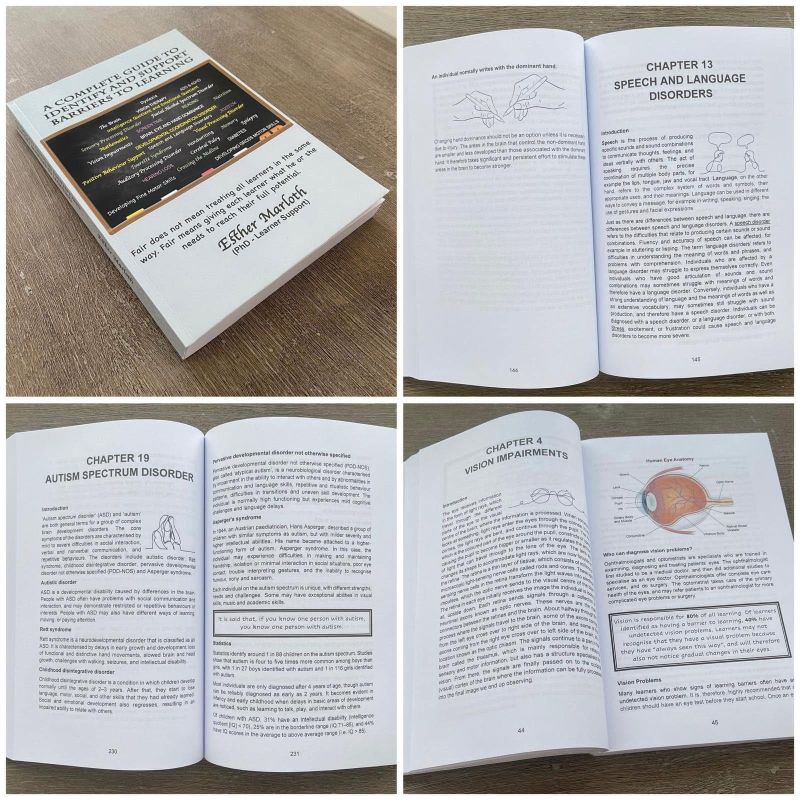
Photographs showing the book cover and sample chapter pages

A consistent chapter structure

Every chapter follows the same three steps.

Once you have read one chapter, you know how to use all thirty. That is what makes it a desk-side reference rather than a textbook.

Understand the topicA clear description of the learning barrier or learning aspect.
Explore possible causes and signsUseful context to support observation and informed discussion.
Apply intervention ideasAccessible strategies for the classroom and home environment.

The full topic index

Every topic, grouped for easy browsing

The book dedicates a full chapter to each topic. Type below to find the one you need.

Learning and cognition

Brain functionHow the brain learns, and what that means for teaching.
IQ and emotional quotientIntelligence, emotional skills and their role in learning.
MemoryWorking and long-term memory in the classroom.
Dominance patternsHand, eye, ear and foot dominance and learning.
ReadingBuilding reading skills and supporting reluctant readers.
DyslexiaRecognising the signs and supporting learners with dyslexia.
HandwritingSupporting legible, comfortable written work.
MathematicsBarriers to number work and how to address them.

Sensory, speech and processing

Vision impairmentSupporting learners with reduced vision.
Visual processing disorderWhen the eyes see but the brain struggles to interpret.
Vision therapyApproaches for strengthening visual skills.
Hearing lossClassroom support for learners with hearing loss.
Auditory processing disorderWhen hearing is fine but listening is hard.
Sensory processing disorderUnderstanding over- and under-responsiveness to sensory input.
Speech and language disordersSupporting communication in class and at home.

Neurodevelopment and health

ADHDAttention, impulsivity and practical classroom strategies.
Autism spectrum disorderUnderstanding and supporting autistic learners.
Developmental coordination disorder (DCD)Supporting learners with motor coordination difficulties.
Cerebral palsyInclusion and participation for learners with cerebral palsy.
EpilepsyWhat teachers and parents should know and do.
Tourette syndromeUnderstanding tics and reducing their impact on learning.
Fetal alcohol spectrum disorder (FASD)Recognising the signs and providing structure and support.
DiabetesSupporting learners managing diabetes at school.

Whole-child support

Positive behaviour supportEncouraging helpful behaviour without constant conflict.
NutritionThe link between what children eat and how they learn.
Screen timeHealthy boundaries for devices at home and school.
Fine motor skillsBuilding the small-muscle control behind writing and self-care.
Gross motor skillsWhole-body movement skills that support learning readiness.
Crossing the midlineWhy this developmental skill matters for reading and writing.

No topics match your search. Try a shorter word, e.g. “vision” or “motor”.

This book is an educational resource. It does not diagnose conditions or replace medical, psychological, therapeutic or educational assessment.

Editions and details

Available in paperback and ebook.

TitleA Complete Guide to Identify and Support Barriers to Learning
AuthorDr Esther Marloth
PublisherDigital On Demand
Published20 September 2024
Length310 pages · 30 chapters
LanguageEnglish
Paperback ISBN978-1-03-702240-1
Ebook ISBN978-1-03-702772-7
Jargon-free, solutions-focused, and deeply practical.

Megan Trickey · iEducation review

“A fantastic resource for parents, teachers and support staff, filled with practical intervention ideas.”

Anina · Reader review